
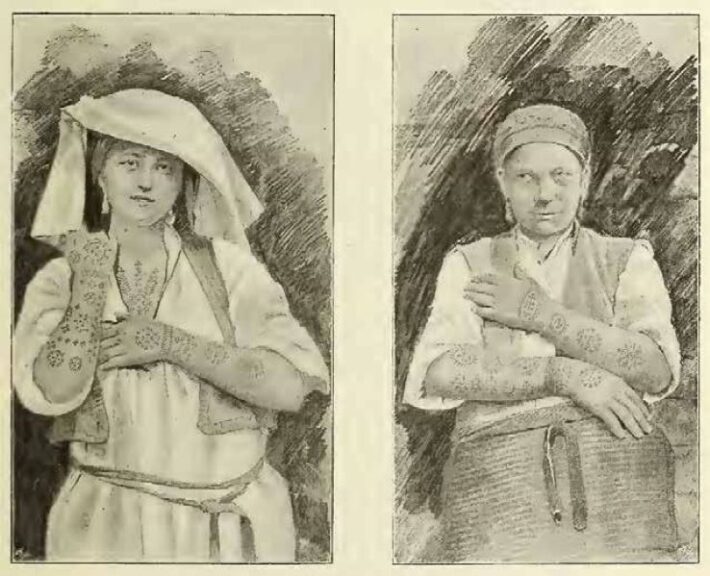
Cover illustrations taken from Dr. Ćiro Truhelka's scientific work – Tattooing of Chatolics in Bosnia and Herzegovina , Gazette of the National Museum XXV, Sarajevo 1913. Illustration 1. A young woman from the Bila Valley. Illustration 2. A girl from the Bila Valley.
Amir Isajbegović
The slave trade from Bosnia is a long-term activity that has been of great importance in the economy of Dalmatian cities since ancient times. The status of slaves and their manipulation are regulated by city statutes. A significant change took place with the appearance of the Ottomans in Bosnia. Then the recruitment of slaves was redirected further east but with the intensification of the war between the Christians and the Ottomans came increased trade with slaves from the territory of the Ottoman Empire. The slave trade from Bosnia in Dalmatian towns was generally intermediary, while the main trade took place in the squares of the towns of the Apennine Peninsula.
Christian Europe considered medieval Bosnia a heretical country and thus unknowingly marked it as a rich source of slaves and which did not have to travel far for them, and with the least effort, a quick and good profit would be made. Slaves belonged to the very bottom of the subjugated dependent people of class medieval society, with the elementary difference from the antique slave being that his master had no right to dispose of slave life.
From the very beginning of the 13th century, popes supported religious persecution and exerted pressure by constantly threatening crusades against Bosnia and its Pataren people. In the period 1235-1241, there was a crusade war against Bosnia, and besides it, there were several other calls for a crusade, but without an official response. And despite the fact that the people of Bosnia paid a high price with their lives in the fight against the policies of Rome and the Hungarians, they did not want to give up their religious beliefs, which perfectly matched their mentality and spirituality in principles and practice. Slave traders managed perfectly in an environment like that.
Towards the end of the 13th century, slaves were transported from Bosnia via the port of Dubrovnik to many cities in the Mediterranean and Europe, to Venice, Genoa, Bari, and further to Marseille, Palestine, Tripoli, and Alexandria.
In the 14th century, the Bosnian slave trade intensified, with a smaller share of men and mostly children in terms of age. The reason why most of the slaves were from the female population can be explained by a different purpose than that of the ancient slaves. Medieval slaves were used to do household chores, as nursing mothers and often as concubines.
In the medieval state of Bosnia, it was considered shameful to engage in the slave trade, so it was done by foreigners. At the same time, slaves were not kept in Bosnia, neither among the nobility nor at court, unlike Dubrovnik and a good part of Europe and the Mediterranean. Considering the number of slaves in the office and notary records of Dubrovnik and in other archives from 1280, we find data that a large part comes from the area of Usora, which is attributed to the homeland of slaves and other peripheral areas of Bosnia – Soli, Donji Kraj, Lower Neretva. Apart from becoming free people as slaves due to poverty and debts, a significant part of slaves was created as a subject of war booty and theft of people and especially children, while the proximity of the border and square in the port of Drijevi on the Neretva guaranteed quick and easy big money. It is documented that during the Crusades in Bosnia in 1248, several thousand heretics were taken away and further sold out in the squares of Europe. Armed groups of foreigners forcibly captured and secretly took people out of the country to make money on them.
With the entry of Bosnia into the territorial framework of the Ottoman Empire, a large number of persecuted and abused patarens found a way out of their troubles.. They are slowly accepting God's new revelation – Islam and changing the previous confession
- The first written mention of slaves in Bosnia
Slaves were first mentioned in Bosnia in a document from the 11th century where the slave Marko, Radoslav's son, was sold at Drijevi Square.
In 1180, the papal legate (Rolando Bandinelli, Pope Alexander III) Theobald in a letter requested from Ban Kulin that two slaves be sent to the pope out of respect for the gift.
 Statement on the sale of the boy Milko 09. November 1389. Dubrovnik
- Names for slaves
Bosnian: „rob“ „čeljad“ „otrok“ „hlap“
Latin: „servus“ „sclavus“ „famulus“
- Slavery and religion
And yet, the business of kidnapping, ransoming, trading, and owning slaves of a different religion was not only a North African or Ottoman affair from 14. century onwards. It followed the Christian-Muslim frontier, from Morocco to the Black Sea, and it was fundamentally reciprocal.
In Bosnia, on the one hand, there were slave traders Sicilians, Catalans, Dubrovnik, and the other members of the Ottoman Empire.
In addition to European robbers and crusaders, theft was also carried out by “Akinci” corps who operated in the area all the way to Udine and Trieste. The Akindjis are part of the military formations of the Ottoman Empire that acted independently as light cavalry and existed on the basis of booty that they would plunder.
In the Middle Ages in Europe, the unwritten rule was that a slave could only be a non-Christian, and in addition to infidels, this category included Bosnian Kristijan heretics, along with Bulgarian Bogomils, French Albigensian Qataris, and Italian Patarens. At the same time, the Catholic Church advocated the abolition of the slave trade, so that King Dabiša's proclamations in 1392 banning the trade in “human flesh”, King Ostoja's 1400 proclamation to the people of Dubrovnik, the proclamations of the Bosnian ruler Stjepan Vukčić Kosača, Pavle Radivojević Jurjević and others followed Dubrovnik's proclamations banning 1400, 1413 and 1416, so that Dubrovnik passed the Law on the Prohibition of the Slave Trade on January 27, 1416. However, that law was not respected. Because it was easy to violate with impunity and because the slave trade brought in large and quick profits, the people of Bosnia continued to be abducted for centuries.
- Sicanje
 Traditional tattoo – SicanjeThe response of the local population to the harsh reality of being left without their children by the robbers was reduced to methods of deterrence. Methods of deterrence included forms of heavier and easier mutilation, and sometime in the late 14th / early 15th century, the practice of marking children with a tattoo with cross motifs began. The parents hoped that this would deter the robbers from stealing their crippled child or marked with a cross motif, as this would make it more difficult for the robbers to trade and reduce their earnings. In that period, the folk custom of Croatian Catholics “sicanje” most probably originated. Arms, chests, foreheads were tattooed with the sign of the cross and ornaments in order to recognize the tattooed persons as Catholics by thieves and/or later by slave traders and their customers, as this indicated that trade would be more complicated in that case. with less profit and possible loss. Due to the ban on trading in Christians in Europe, slaves tattooed with cross motifs had to be transported further to the squares of Alexandria, Tripoli … For example, the Grand Council of Korčula, by a decree from November 1387, issued an order that every slave who is found to be a Catholic must be released unconditionally. Only children of the Pataren faith were allowed to be brought to Dubrovnik from Bosnia because Catholics could not become slaves.
The very name of the custom “sicanje” has two possible roots:
The first possible root is that “sici” or “sicati” comes from the verb “sječi” (siči) which is connected to the action of cutting on the body during mutilation.
Another possible root is that “sicanje” or “sicati” comes from the Turkish verb (sakat tur.) “Sakaćenje” or “sakatiti” which means to cripple.
The importance of being a Christian in order not to fall into slavery is also shown by the famous event in which three Bosnian slave girls were bought by the Catalan merchant Petar Doia on the square in Brštanik. After proving that they were Christians, slaves Stojna, Tvrdislava, and Grlica were immediately released by the Dubrovnik court.
- Robci
Towards the end of the Bosnian kingdom and during the Ottoman rule of Bosnia, a special group of bandits was defined by name. They were called the “Robci” and that group forcibly captured men, women and children to sell them into slavery. The “Robci” are also mentioned in the Latin terminology of the Dubrovnik notary office.
- A place of the slave trade
The strongest place of the slave trade from Bosnia took place on the square in the port town of Drijevi on the Neretva and on the square Brštanik also on the Neretva river below the eponymous hillfort Brštanik. Both places had strong colonies of Dubrovnik merchants. According to records, slaves were taken from there to Florence, Ancona, Messina, Genoa, Pisa, Barcelona, Palermo, and beyond.
In the new century, after the founding of Sarajevo, the slave trade took place on “At Mejdan” Square.
- Slaves in the Kingdom of Bosnia
We have no preserved original Bosnian documents on the condition of slaves and their position in the Kingdom of Bosnia. What we can conclude from documents from other archives is that the Bosnian rulers stood up to protect their people who were captured and taken into slavery by foreigners. Based on royal proclamations, Bosnia was one of the first European medieval countries to be resolutely against slavery. In Bosnia at that time, it was shameful to keep and trade slaves
- Slaves in Ottoman Bosnia
The national and religious affiliation of the slaves, age, sex, for which the jobs were used and their purchase price were documented in the court sidjils. Sidjils are a source of knowledge about the position and condition of the slaves of Ottoman Bosnia.
Based on the names, it can be determined that most of them were of the Islamic faith, and they came to Bosnia from the border areas of Croatia and Hungary. The purpose of the slaves was to work in the house, rarely in agriculture, and the ratio by sex was uniform. Many of the slaves converted to Islam, thus easing their position and gaining their freedom. At the same time, Muslims believed that the liberation of slaves was a godly act. The greatest liberation of slaves took place when they went on a pilgrimage (Hajj) or when someone fell ill. We often have cases where freed slaves have made great strides and come to high positions.
- The biggest slave traders
According to the number of slaves purchased, they stood out the most:
Žore Bokšić the tenant of the customs and the royal protovestiary and his wife Maruša,
Ruskoje Silović, a slave trader from the Neretva
Mangano from Dubrovnik,
Ricardo Giuliani from Bari,
Petrelo de Maselo from Ancona,
Antonio, son of Jacop,
Leo Mazi,
Bernardo Katalan.
- Slave trade and DNA
From the Bosnian genetic pool, the slave trade caused the medieval migration of the Y-DNA I haplogroup and especially the mt-DNA V haplogroup throughout the Mediterranean and Europe.

Map of distribution haplogroup V
- From the notarial records of the Dubrovnik archive
a) „Dragoslaua de Vssora confiteor quod ego et Pribil filius“, Dragoslava from Usore declares as her son Pribil…
b) „Radoslauam filiam Stoyci de Vxora Nicus Petri Saxinuucih“, Radoslava daughter of Stojko from Usora slave property of Nikle Petra Sasimovića… 1365. years
c) „Budislauom filiam Veselchi de Vsora“, Budislava daughter of Veselko from Usora… 1367. year
d) „Stoyna filia Michos de Batun de Srebrenich cum filio meo Tuertcho“, Stojna daughter of Mikos from Batun near Srebrenik with son Tvrtko… 1370. years
e) „Moymili de Vxora“, Mojmila from Usora… 1370. year
f) „Bogoslauam filiam Medossii de Vxora“, Bogoslava daughter ofi Medoša from Usora… 1377. year
g) „Stoxyacam filiam Ratehi de Vxora“ Stojaca daughter of Ratko from Usora… 1377.year
h) „Miloslana filia ostoye Obrenouich de Vsora“ Miloslava daughter of Ostoja Obrenović from Usora… otherwise, she was bought by Žare Bakšić (Georgius Boxe), in Podvisoko from Gojlano Bogdancich (Goyslano Bogdancich) and sold to Marin Gundulić (Mariono de Gondola) for 14 ducats
i) „Pribislaua filia Raossi de Vssora“, Pribislava daughter of Rados from Usora
j) „Goyna et Latine Symonam filiam, Radoe de Uxora de Bossina patarenam“, Gojna with the Latin name Simona, daughter of Radoje from Usora, Bosnian pataren … 1397. year
k) „Goyslaua filiam Vocoslaui de Vssora de Bossina patarenam“, Gojislava daughter of Vukoslav from Usora, Bosnian pataren… 1398. year
l) „Dragnna filia Milse de Vssora“, Dragna daughter of Milsa from Usora… 1398. year
m) „Iuica filia Pricod partium Vssore de Bossina generis patarenorum“, Ivica daughter of Prihoda from Usora Bosnian pataren origin… 1398. year
- Examples of slave names from archives
– Gojna from Usora in 1316 resold in Bari for 16 perpers
– Pribislava, daughter of Stojko from Usora in 1370.
– Tvrdislava, daughter of Petko from Usora in 1374.
– Pribna from Prača, 1378.
– Milna from Bosnia, 1381.
– Katarina 8 years, Zoja 10 years, Ivica 11 years, Gojna 12 years, Draginja 13 years, Janja 14…
– Milost, Radost, Dragost, Negost, Dobrost, Ulkost, Drugost – these names make up one-fifth of all slaves sold
References:
1) A. Solovljev, Trgovina bosanskim robljem do godine 1661., Glasnik Zemaljskog muzeja, Sarajevo 1946.
2) Ć. Truhelka, Glasnik Zemaljskog muzeja XXV, Sarajevo 1913.
3) A. Babić, Roblje, Prilozi za historiju BiH, Društvo i privreda srednjovjekovne bosanske države, ANUBiH, knjiga LXXXIX, knjiga 17, Sarajevo 1987
4) V. Vuk, Trgovina bosanskim robljem XIV vijeka u Dubrovniku, Anali Povjesnog instituta JAZU, II, Dubrovnik 1953.
5) M. J. Dinić, iz Dubrovačkog arhiva, knjiga III, SANU, Beograd 1967.
6) Elmedina Duranović, Žene iz Bosne na tržištu roblja u Dubrovniku 1279-1301.,Historija umjetnosti, Arheologija, Knjiga 3, Filozofski fakultet u Sarajevu, Sarajevo, 2014.
7) Zdenko Tomislav Tenšek, Krstjani i trgovina robljem na Sredozemlju između 13. i 15. stoljeća, Fenomen „Krstjani“ u srednjovjekovnoj Bosni i Humu, Institut za istoriju u Sarajevu – Hrvatski institut za povijest, Sarajevo – Zagreb. 2005.
8) Đuro Tošić, Brštanik u srednjem vijeku, Sarajevo, 1976.
9) Đuro Tošić, Trg Drijeva u srednjem vijeku, Sarajevo, 1987.